Painting interior doors well comes down to prep: cleaning off hand oils, filling dings, sanding for grip, priming bare or glossy spots, then laying down thin, even coats of a durable enamel. Hiring a painter in Braintree makes sense when you want smooth, brush-mark-free panels, careful handling of hardware, and lead-safe prep on older homes. Expect the prep to take longer than the painting.
Key Takeaways
- Most of a good door finish comes from cleaning, sanding, and priming before any enamel goes on.
- No checked source publishes a per-door price; door style, condition, and removal drive the cost.
- Older homes that may hold lead paint need lead-safe prep from a certified contractor under EPA rules.
How does a painter paint an interior door?
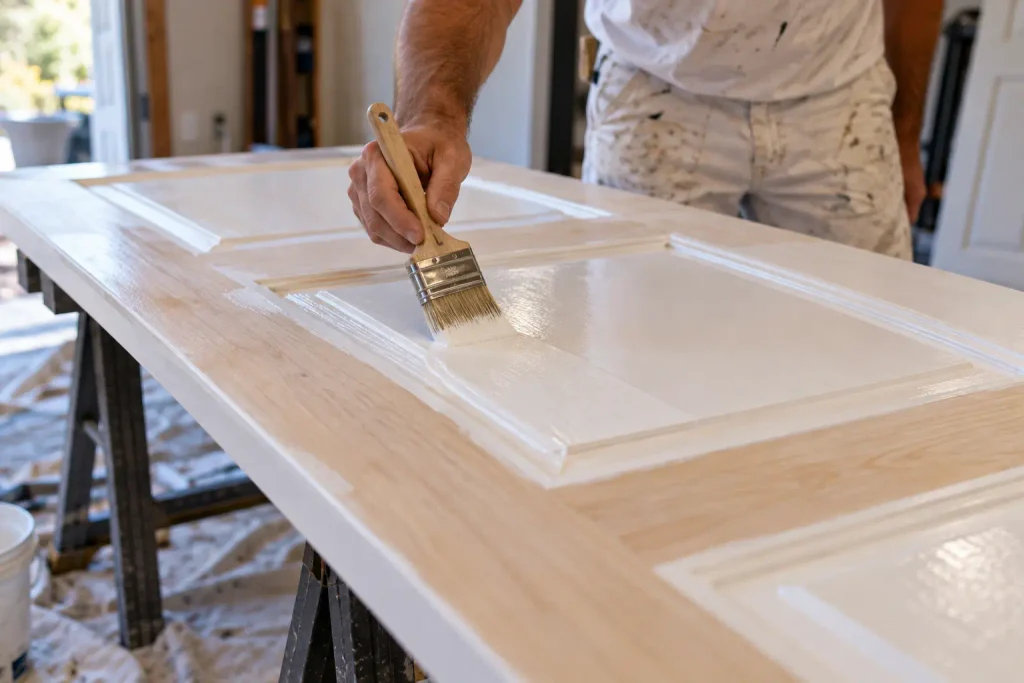
A painter cleans the door, repairs damage, sands the old finish dull, primes where needed, and applies thin enamel coats, either with the door on its hinges or taken down and laid flat. Panel doors get painted in a set order so wet edges blend and no lap marks show.
Here is how we run it on a typical door:
- Assess the surface. The U.S. Department of Housing and Urban Development (HUD) defines deteriorated paint as paint that is peeling, chipping, chalking, cracking, or separated from the surface. Any of that has to come off before new paint goes on.
- Handle the hardware. Knobs, strike plates, and hinges get removed or masked, never painted over.
- Clean. The area around the knob collects hand oils that keep new paint from bonding.
- Repair. Dents and gouges get filled. A split stile, loose panel, or damaged jamb needs carpentry and wood repairs first.
- Sand and prime. Scuff-sanding gives glossy old enamel some tooth, and primer seals patches and bare wood.
- Paint in order. Panels first, then the horizontal rails, then the vertical stiles, finishing the edges last.
- Cure before closing. Enamel that feels dry can still stick to the stops, so doors stay open until the finish hardens.
What does it cost to paint interior doors?
On the South Shore, homeowners can typically expect to pay about $75 to $200 per interior door for professional painting. A simple, smooth door in good condition will usually fall toward the lower end, while paneled doors or doors that need sanding, repairs, priming, or a major color change can cost more. Labor makes up most of the price because proper prep and multiple coats are what create a smooth, durable finish. Painting several doors as part of a larger interior painting project may also lower the cost per door.
These are the factors that move a quote up or down:
- Door style. A flat slab paints faster than a raised-panel, louvered, or French door with glass to cut around.
- Condition. Peeling, heavy dents, or failed old coats add scraping, filling, and priming time.
- Scope. Painting both faces, the edges, the jamb, and the casing is more work than refreshing one side.
- Color change. Going from dark to white, or oil to latex, usually means an extra primer coat.
- Removal and spraying. Taking doors down, transporting them, and rehanging adds handling but can speed finishing.
- Lead-safe practices. Pre-1978 homes may require containment and cleanup steps that take extra time.
- Batching. Doing every door in the house in one visit spreads setup time across more doors.
If you want to understand the labor side, the Bureau of Labor Statistics wage tables publish official pay data for painting occupations., and property managers can compare commercial interior painting costs.
How do you choose the right approach to painting interior doors?
Pick the approach based on the door’s condition, how long you can live without it, and the finish you expect. Brushing in place works for a light refresh. Removing and spraying gives the smoothest factory-like surface. A door with structural damage should be repaired or replaced before anyone paints it.
| Approach | Best for | Finish | Trade-offs |
|---|---|---|---|
| Brush and roll on hinges | Light refreshes, occupied homes | Good, with some brush texture | Door stays usable; edges and hinge side are fussier |
| Remove and brush flat | Panel doors needing even coverage | Hardly any sag, cleaner edges | Door is out for a day or more |
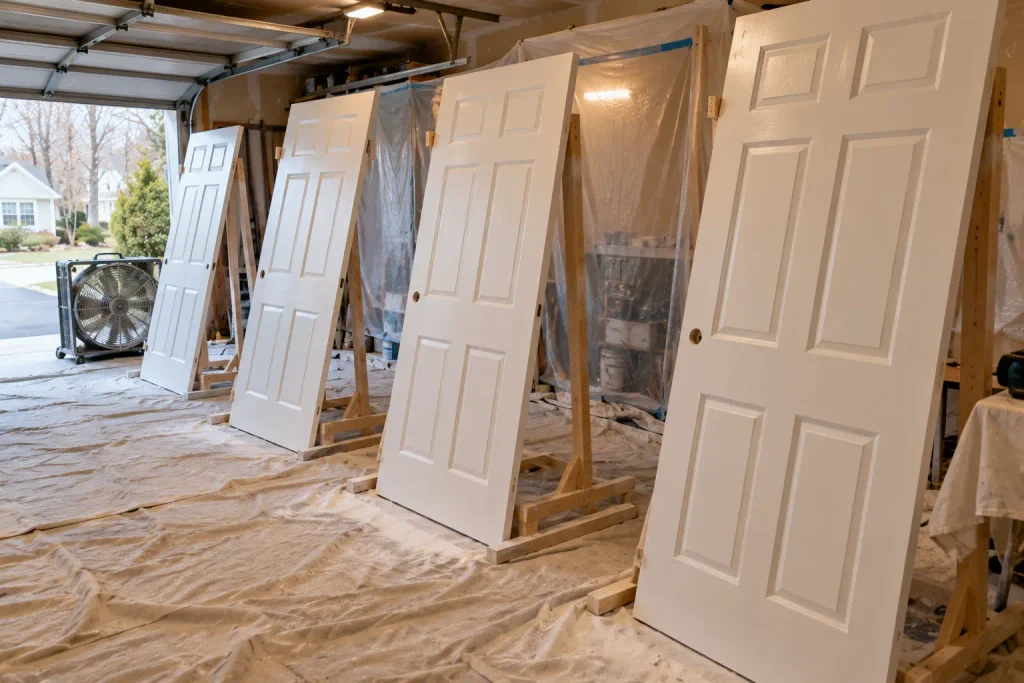
| Remove and spray | Many doors, high-gloss or smooth looks | Smoothest, most uniform | Needs a clean, controlled spray area |
| Repair or replace first | Split, warped, or water-damaged doors | Depends on the fix | Adds carpentry before painting |
Spray painting doors outside only works on dry, calm, mild days in Braintree. Otherwise wind, pollen, and dust land in the wet finish, so a garage or shop setup is the better choice.
Air quality matters whichever method you choose. The EPA notes that paints and coatings release volatile organic compounds (VOCs) that raise indoor pollutant levels during and after a project, so we ventilate the work area and talk through lower-VOC products before starting.
What should you ask before hiring someone to paint your doors?
Ask how the painter handles prep, lead, and hardware before you ask about price. If your home was built before 1978, the EPA’s Renovation, Repair and Painting Rule requires certified contractors to follow lead-safe work practices when disturbing paint, and sanding a door counts.
The EPA’s lead guide for families explains how lead paint is identified and managed during work like this. Questions worth asking:
- Will you test or assume lead on older doors, and how do you contain dust?
- Do you remove doors or paint them in place, and why for my doors?
- Who fixes a split jamb or loose panel if you find one?
- What primer and enamel will you use, and how long before doors can close?
- How will you protect floors and hardware?
I’m Steve Austin, and I’ve owned and managed rental properties since the mid-90s, so I see doors the way both homeowners and property managers do. Doors take more hand contact than almost any other painted surface, and a finish that skips prep wears through at the edges fast. Because we’re a family-owned and operated company with full-time carpenters alongside our painters, a damaged door gets fixed by our own crew before the paint goes on. Homeowners and managers across the area can learn more about our painters serving Boston and the South Shore.
When you’re ready to get your doors looking right again, start with our interior painting services and call us at 781-356-2050.
Get in touch to plan your project.
Sources
- Lead Renovation, Repair and Painting Program – U.S. Environmental Protection Agency, retrieved 2026-09-26
- Protect Your Family from Lead in Your Home – U.S. Environmental Protection Agency, retrieved 2026-09-26
- Volatile Organic Compounds’ Impact on Indoor Air Quality – U.S. Environmental Protection Agency, retrieved 2026-09-26
- Visual Assessment Training – U.S. Department of Housing and Urban Development, retrieved 2026-09-26
- Occupational Employment and Wage Statistics (OEWS) Tables – U.S. Bureau of Labor Statistics, retrieved 2026-09-26