Plaster Vs Drywall
Choosing plaster or drywall comes down to the walls your house already has and what you need them to do. Steve Austin, owner of Quality Preferred Painting in Braintree, wrote this for homeowners in Boston and the South Shore. It covers how each wall is built, how the two compare day to day, what sets their price and whether cracked plaster is worth saving.
Key Takeaways
- Keep old plaster that still grips its lath, and save tear-out and new drywall for the sections that have pulled loose.
- Count on the insulation behind the wall for warmth, whichever finish you pick; the wall surface itself does little to hold heat.
- If a noisy room is the worry, lean toward plaster, since its heavier coat damps the vibration that carries sound through a wall.
How plaster walls and drywall are built
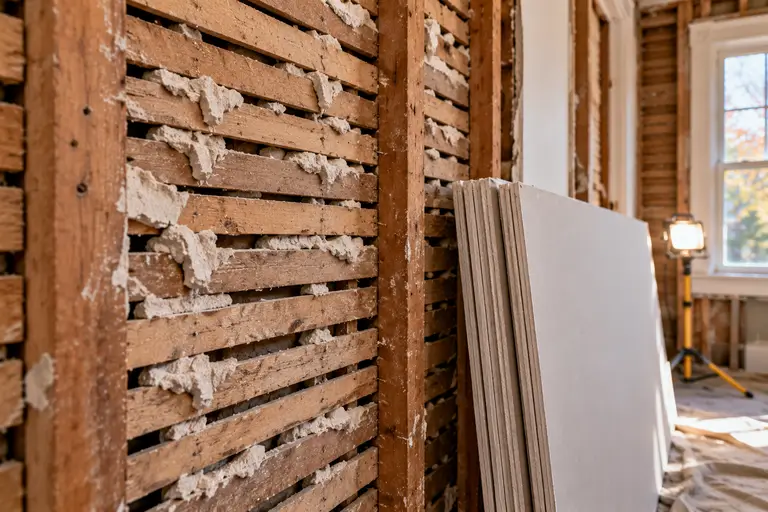
Plaster goes on wet, in layers, while drywall goes up as finished panels. Plaster is a paste of lime or gypsum, sand and water that hardens as it dries. In older homes it was troweled over lath, which is narrow wood strips nailed across the studs. The first coat pushes between the strips and curls behind them into “keys” that grip the wall; later coats build it flat and smooth.
Drywall, also called wallboard, is a gypsum core faced with paper, screwed or nailed to studs and ceiling joists. Its seams are taped and covered with joint compound, then sanded before paint.
Durability, sound, insulation and feel compared
Plaster is the harder, denser wall; drywall is the easier one to install and patch. A cured plaster coat shrugs off knocks from furniture and doorknobs that would dent a drywall panel’s paper face. Plaster also has no paper facing, which is part of why mold struggles to take hold on plaster, while drywall paper that gets wet can feed it. By hand, plaster feels solid, with the slight wave a trowel leaves. Drywall reads flatter and more uniform.
Why does plaster work need a skilled plasterer?
Plaster is shaped by hand while it hardens, so the wall is only as good as the person holding the trowel. The mix has to reach the right stiffness. Each coat then has to be worked at the right moment: too wet, it slumps; too far set, it drags instead of troweling smooth. Drywall panels arrive flat from the factory. A plaster wall gets flat only through the plasterer’s eye and arm, working across the whole surface before the coat sets. Patching an old wall adds another test: matching a texture someone troweled long ago. That hand time is much of what goes into the cost of hiring a plasterer.
What drives the cost of plaster versus drywall
Plaster costs more than drywall because it is built by hand, and its price climbs with the prep the old wall needs. Fixr’s plaster cost guide and homewyse’s gypsum plaster calculator price it this way:
| Source | Figure | What it covers |
|---|---|---|
| Fixr, national | $450 to $550, averaging $500 | Plaster application, 100 sq ft project |
| Fixr | $1 to $3 per sq ft, adding 10% to 30% to project costs | Prep work, set by the surface’s condition |
| homewyse, September 2026 | $5.62 to $6.79 per sq ft | National average with labor, materials and delivery |
Drywall is quoted separately; have a plastering contractor price both for your walls.
What upkeep do plaster and drywall walls need?
Both need little beyond repainting until something shifts or gets wet. The difference is what you watch for. On plaster, look for cracks that keep widening, or a spot that sounds hollow when you tap it, which can mean the keys have let go of the lath. Caught early, that is a patch. Left alone, the area can loosen and fall. On drywall, the signs are nail pops and paper that bubbles after a leak. Letting plaster go costs more later: HomeGuide’s plastering cost guide puts plastering walls at $2 to $12 per square foot, depending on the existing surface material and condition. A quote for your walls sets your own number.
Does plaster block sound better than drywall?
Yes, as a rule. Sound travels through a wall by making it vibrate, and a thick, heavy coat of plaster on lath resists that vibration better than a lone sheet of drywall. How quiet a room ends up depends on more than the wall’s surface, though. Gaps around outlets, doors and ductwork let sound through either kind of wall. If privacy between rooms matters, ask what fills the cavity behind the finish and whether a second layer of drywall would help your walls.
Which insulates a home better, plaster or drywall?
Neither one does much on its own. Plaster and drywall are both thin finishes, so how warm a room stays depends on the insulation in the wall cavity behind them. Drywall’s edge comes from the work itself: with old plaster and lath torn out, the open stud bays can be insulated before new panels go up. Before any old plaster comes down, have it tested for lead and asbestos, and hire a contractor certified for lead-safe renovation to do the tear-out. A plaster wall you keep can still be insulated by blowing material into the cavity through small holes that are patched afterward. Old plaster walls often hide knob-and-tube wiring, which must not be buried in insulation, so have an electrician check the cavities and replace or clear any live wiring first. Before choosing, find out what fills your walls now.
What to look for in a plaster or drywall contractor
Look for a contractor who will repair plaster rather than quote drywall for every cracked wall. Ask how they would fix your worst crack, and have them show you a repair they finished on an older wall. A contractor who handles both plastering and paint can take a patch to a finished coat in one job, with no wait between trades. If your home is in Hingham, ask whether that same crew does interior painting in Hingham, MA once the walls are sound.
How to tell whether your walls are plaster or drywall
Press a pushpin into the wall somewhere out of sight. It slides into drywall’s paper face under thumb pressure; plaster stops it cold. For a closer look, turn off the circuit and remove a switch plate. Drywall shows a thin board with a paper edge. Plaster shows a thicker, chalky layer, sometimes with wood lath behind it. Knocking helps too: drywall between studs sounds hollow and flexes slightly, while sound plaster gives a dull thud and does not move.
Why drywall replaced plaster in most new homes
Speed won out. Drywall panels arrive ready to hang, and the only wet work is the joint compound at the seams, so a builder can close in a new house in much less time than a plaster crew needs. Plaster brings water into the house by the bucket. Each coat has to set before the next goes on, and the finished wall has to dry out before it will take paint. Every trade scheduled behind the plasterer waits through those days, and on new construction that idle time costs the builder money. Labor shifted too. Hanging and taping board can be learned on the job, while a plasterer’s hand takes a long apprenticeship to develop, and fewer people entered that trade as drywall spread.
Old plaster walls: repair them or replace them with drywall?
Repair them if most of the plaster is still tight to the lath; replace with drywall only where it is not. A cracked wall that is otherwise solid can be patched, and loose sections can often be screwed back to the lath with plaster washers before the cracks are filled. Repair leaves the original trim and door casings in place, which a tear-out tends to disturb. Drywall makes sense where a ceiling sags across a wide area, where water has turned the plaster soft, or where the wall is coming open for new wiring anyway. Demolition is the messy route, since plaster and lath come down as heavy, dusty debris. Older plaster walls often carry decades of paint, so learn about lead paint in older South Shore homes before anyone sands or breaks into them.
If you are weighing repair against replacement for your own walls, contact Quality Preferred Painting or call 781-356-2050 and tell us what you are seeing.
Sources
- How Much Does Plastering Walls Cost? (2026) – HomeGuide, homeguide.com, retrieved 2026-10-07.
- Cost of Plasterer | Plastering Prices | Fixr.com, Fixr.com (Cost Guide), retrieved 2026-10-07.
- Cost to Apply Gypsum Plaster – 2026 Cost Calculator (Customizable), homewyse.com, retrieved 2026-10-07.