Nationally, a dry rot repair typically starts at $592 to $1,112 per repair, according to Homewyse’s 2026 cost calculator. Replacing rotted boards with sound wood keeps water out of your walls and roofline. Quality Preferred Painting, a Braintree painting and carpentry company, explains what South Shore homeowners pay by where the rot sits, why quotes differ and how to keep it from returning.
Key Takeaways
- Note where the rot sits before asking for prices. A window sill and a roofline fascia board land in different cost bands.
- Compare quotes by the carpentry each one prices. The labor behind two similar-looking soft spots can be billed differently.
- Budget for the repair to grow once boards come off. Dry rot can spread past the wet spot you can see.
- If your South Shore house still wears its original exterior wood, inspect it closely. Generations of weather make rot a frequent repair there.
- Read failing paint over wood as the first warning sign of rot, well before any board softens enough to give way.
- Patch only when firm wood surrounds a shallow soft spot. Once decay reaches through the board, plan on a new piece.
How Much Does Wood Rot Repair Cost in Massachusetts?
Wood rot repair in Massachusetts typically costs $200 to $4,000 in 2026, and most South Shore homeowners spend $500 to $1,100 on one localized repair.
Cost guides price narrower pieces of the work: Homewyse’s dry rot calculator, HomeGuide’s soffit and fascia guide and HomeGuide’s carpenter rates. Only Homewyse states a region (national).
| Guide | What it prices | Typical range |
|---|---|---|
| Homewyse, May 2026 | Dry rot repair, per repair | $592 to $1,112 |
| HomeGuide | Soffit and fascia, small sections | $9 to $34 per linear foot |
| HomeGuide | Soffit and fascia, full replacement | $900 to $6,800 |
| HomeGuide | Finish carpenter labor | $40 to $100 per hour |
| Angi | Localized window or door trim | Starting around $200 to $500 |
Wood Rot Repair Cost by Location on the House
Minor work like a rotted window sill or section of trim runs $200 to $700, while moderate damage to fascia, siding or framing climbs to $1,000 to $4,000. Where the rot sits decides which band a repair lands in.
Window Sills and Trim
Once a sill’s paint cracks, water soaks its end grain and the wall below. Angi puts a straightforward window sill replacement at an average of $400, with most homeowners paying $150 to $700, or roughly $75 to $100 per linear foot including materials and labor.
Fascia and Soffits
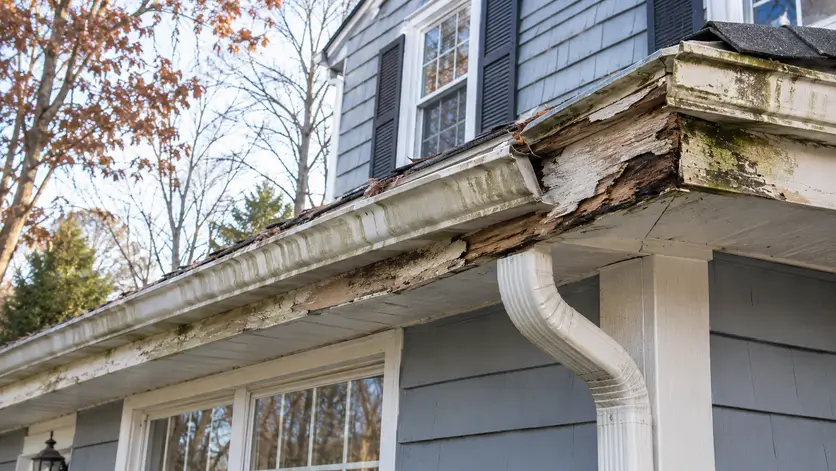
Fascia is the board along the roofline that the gutter hangs on. The soffit closes in the underside of the overhang. Angi gives a typical fascia board replacement an average around $2,500, commonly ranging $1,050 to $3,300. HomeGuide’s soffit and fascia cost guide puts roof eaves repair at $500 to $2,600 on average for work such as replacing rotted sections of fascia and soffit or fixing rafter tails, the rafter ends the fascia is nailed to.
Wood Siding
Clapboards and shingles often go soft at the bottom courses and against window casings. HomeGuide’s wood siding repair guide puts minor repairs, such as patching small cracks or woodpecker holes, at $200 to $800 and larger sections at $800 to $3,000, with per-square-foot pricing from about $6 to $30 depending on the wood species.
Door Frames, Posts, and Structural Wood
Framing sits in the moderate band above. A rotted door jamb or porch post may need shoring while the bad wood comes out. Its price turns on whether that member carries load.
Sills, Window Trim, Fascia or Siding: How Location Changes the Job
A sill can usually be worked from a short ladder. Fascia needs ladders or staging along the roofline. Our carpentry team on the South Shore replaces rotted wood in each of these spots and matches new pieces to your home’s existing details. Your own price comes from a quote on your house.
What Drives How Much It Costs to Repair Wood Rot, and Why Does It Vary?
Two soft spots that look alike can still draw different quotes, because the labor behind them is priced differently. HomeGuide’s carpenter rate guide names what moves that labor cost:
- The kind of carpentry. Framing, trim and finish carpenters do different work and vary in price.
- Experience. Carpenters with more experience tend to charge more on any project.
- Who hires the carpenter. One brought in by a general contractor may cost more than one you hire directly.
- Travel. A job outside a carpenter’s usual service area can carry a fee for travel time.
- Get at least 3 itemized estimates to compare.
- Browse reviews on HomeGuide and Google.
Dry Rot, Wet Rot and Why the Damage Is Often Bigger Than It Looks
Wet rot needs saturated wood and stops spreading once the water source is gone. Dry rot can take hold in less wet wood, then send strands behind plaster or along framing far from the leak, per Permagard. Dry rot cracks across the grain into cube-like blocks. Wet rot tears into stringy fibers along the grain and feels damp.
Why Is Wood Rot So Common on Older South Shore Homes?
Older South Shore houses still carry much of their original exterior wood, including trim, sills and clapboard that have weathered for generations. Soft, spongy or crumbling wood around a window, door or roofline is one of the most common repairs we make on them. Winters add freeze-thaw. Water gets into a hairline crack in the paint and freezes. The ice expands and pries the wood open, so the next rain soaks in deeper. That same moisture also shortens how long exterior paint lasts in New England.
Age brings a second concern. Many older homes have lead paint under newer coats. Cutting out rotted, painted wood can release lead dust, so the repair calls for lead-safe work practices. Our guide on lead paint in older South Shore homes covers that risk in more detail.
What Are the Early Signs of Wood Rot?
Rot usually announces itself in the paint and the surface of the wood well before a board gives way. These are the signs listed in Bob Vila’s guide to wood rot:
- Paint that peels, bubbles or looks wavy over wood. Failing paint is often the first flag you can see.
- Wood that gives under a screwdriver. Press the tip firmly into a sill or trim board. If it sinks or crumbles, rot has started.
- Dark staining or a musty smell near windows and doors.
Should You Repair or Replace Rotted Wood?
Repair when the rot is shallow and the wood around it is sound. Replace when decay runs through the board. You only know which once the soft wood is dug out to firm wood.
Can Rotten Wood Be Repaired, or Does It Need Replacing?
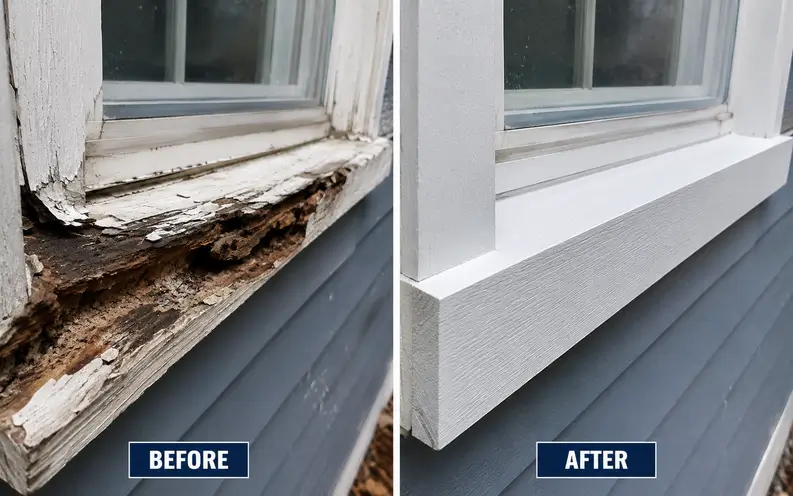
A small pocket of surface rot can be cut back to solid wood, hardened with an epoxy consolidant, then filled with epoxy, shaped and primed. That can save an old molded sill or casing that is hard to reproduce. Once decay goes through the board’s thickness, filler only hides it, and that section needs new wood cut in.
Ask whoever inspects it how much sound wood remains and why they chose a patch or a new piece. If the answer is replacement, the job becomes carpentry on the South Shore rather than paint prep.
Why Wood Rot Repair Should Come Before Painting
Repair the rot first, then paint. Paint covers decayed wood but does not stop the decay, so any soft section has to be cut back to sound wood and patched or replaced before a brush touches it.
Once the wood is sound, caulking the joints and painting seal it against the water that started the rot. Our article on making carpentry repairs before painting goes through the reasons in more depth. The fixes themselves are shown in our overview of carpentry and wood repairs at home. Sound, sealed wood is then ready for our exterior painting service on the South Shore.
How to Prevent Wood Rot
Rot needs wood that stays wet, so prevention means keeping water off exterior trim and letting it dry out when it does get wet. The U.S. Environmental Protection Agency warns that if a roof is allowed to leak long enough, molds can weaken floors and walls by feeding on the wet wood.
Keeping Rot From Coming Back
Start at the roofline. A clogged gutter or a downspout that empties beside the foundation soaks fascia and the lower siding courses with every storm, so keep them clear and aim the outlets away from the walls.
Touch up cracked paint or split caulk while the gap is still small. That opening is where water gets back in.
Get a Free Wood Rot Repair Estimate on the South Shore
Once you have found soft wood, the next step is having someone open it up to see how far the decay runs, because that is what sets your price. Quality Preferred Painting is a family-owned company based in Braintree that offers both carpentry and exterior painting, so replacing the rotted wood and painting the new pieces can be handled as one job. We work in Braintree and across the South Shore and surrounding communities. Call 781-356-2050 or request a free estimate, and we will look at the damaged wood with you.
Frequently Asked Questions
How much does it cost to replace rotted wood around a window?
Replacing a rotted window sill or a section of the trim around it runs $200 to $700. If the soft wood has reached the framing under the sill, the job moves into the $1,000 to $4,000 range.
Is wood rot covered by homeowners insurance?
Usually not. Most policies treat rot as a maintenance issue rather than “sudden and accidental” damage, so gradual decay from moisture is typically excluded. Rot resulting from a covered event (like a burst pipe) may be different, check with your insurer.
Can you just paint over rotted wood?
No. Paint over rotted wood fails early because the soft wood under it keeps taking on water, swelling and shrinking until the new coat cracks and peels. You then pay to repaint that spot after the wood is fixed.
How fast does wood rot spread?
Wet rot stays near the moisture feeding it, but dry rot keeps spreading through framing and even masonry, per Permagard. Putting off the repair while it spreads is what turns a $400 fix into a $5,000 one.
How do I know if my wood is rotted or just weathered?
Weathered wood turns gray and rough and may show surface cracks, but it stays hard when you press on it. Rotted wood gives way or crumbles. Weathered boards can be sanded and repainted, while soft wood has to be cut out first.
Sources
- Cost to Repair Dry Rot – 2026 Cost Calculator (Customizable), Homewyse, retrieved 2026-11-08.
- How Much Does Soffit and Fascia Repair Cost? (2026), HomeGuide, retrieved 2026-11-08.
- How Much Does Wood Siding Repair Cost? (2026), HomeGuide, retrieved 2026-11-08.
- How Much Are Carpenter Hourly Rates? (2026 Prices), HomeGuide, retrieved 2026-11-08.
- Mold Course, Chapter 2, U.S. Environmental Protection Agency.